
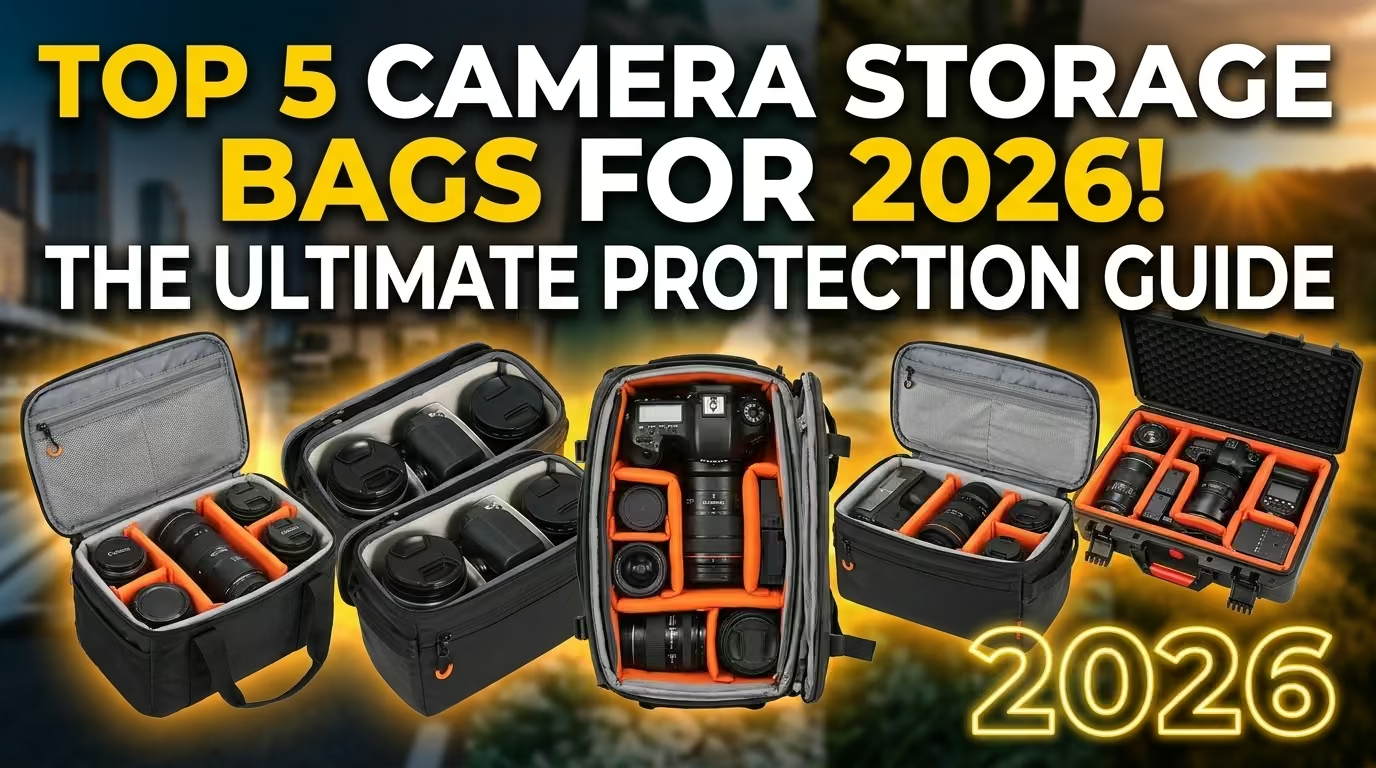
storing camera-top 5 camera storage lenses bags for 2026
The professional landscape of photography in 2026 is defined by a dichotomy between increasingly sensitive high-resolution hardware and the rugged, unpredictable environments where that hardware is deployed. As optical sensors move toward higher megapixel counts and integrated artificial intelligence becomes standard in bodies like the Sony $\alpha$7 V and the Fujifilm GFX100S II, the physical infrastructure for storing camera equipment has shifted from being a secondary accessory to a primary necessity for asset preservation. The global market for camera bags and storage solutions, now valued at over $1.2 billion, reflects a sophisticated understanding of environmental risks including humidity, mechanical shock, and electrostatic discharge. Practitioners are no longer merely looking for a container; they are seeking a controlled environment that ensures the longevity of their technical investments.
The methodology of storing camera gear has evolved to address the biochemical and physical threats that can render expensive optics and electronics useless. Humidity, in particular, remains the most significant threat, as levels exceeding 60% relative humidity promote the growth of fungus on lens elements, while extremely dry conditions can lead to the cracking of rubber seals and the degradation of essential lubricants. Consequently, the industry has seen a massive influx of “smart” storage solutions, ranging from airtight hard cases with integrated desiccant chambers to electronic dry cabinets that offer precision climate control. This report provides an exhaustive analysis of the top five storage solutions of 2026, evaluating their performance through the lenses of material science, structural engineering, and practical field utility.
Miniature and structural games for camera equipment
Understanding the requirement for storing camera gear at home or in the field necessitates a review of the physiological risks posed to modern optics. Lenses are complex assemblies of glass, metal, and polymers, often containing multiple coatings that are susceptible to etching from fungal spores. When storing camera equipment, the primary objective is to maintain a relative humidity range between 40% and 50%. Expert consensus from organizations like Sony and StorageCafe indicates that this range is high enough to prevent lubricant evaporation but low enough to inhibit the germination of Aspergillus and other common molds.
Beyond humidity, the mechanical orientation of stored gear significantly affects its long-term health. When storing camera with lens attached, the weight of the lens puts a constant torque on the mount of the body. Over years of storage, this can lead to micro-misalignments in the lens mount, potentially affecting the focus accuracy of high-resolution sensors. Therefore, official guides strongly recommend that practitioners detach lenses for long-term storage, capping both the body and the rear element to prevent dust ingress. Furthermore, when storing camera gear at home, placing lenses vertically with the front element facing upward is the preferred method to minimize stress on internal barrel mechanisms and prevent the migration of lubricants into the optical stack.
Comparative Environmental Tolerance and Storage Requirements
| Environmental Factor | Optimal Range for Storage | Risk of Deviation | Recommended Mitigation |
| Relative Humidity | 40% – 50% RH | >60%: Fungus growth; <30%: Seal cracking. | Electronic dry cabinets or silica gel. |
| Temperature | 50°F – 70°F (10°C – 21°C) | High heat: Battery degradation; Cold: Condensation. | Climate-controlled units. |
| Air Quality | Dust-free / Sealed | Scratches on glass, sensor spots. | IP67-rated hard cases or dry boxes. |
| Structural Load | Vertical, Separate | Mount warping, lubricant migration. | Dedicated shelving or custom dividers. |
| Electronic State | Batteries Removed | Terminal corrosion, chemical leakage. | Labeled battery tubs. |
The importance of storing digital camera assets correctly extends to the data itself. A comprehensive storage strategy for 2026 includes the physical protection of media. Practitioners are advised to treat storing camera sd card assets with the same level of care as the bodies themselves, using anti-static, waterproof cases to prevent data loss from physical damage or environmental exposure. The use of external hard drives and Solid State Drives (SSDs) for archival purposes requires a 3-2-1 backup strategy: three copies of every file, on two different types of media, with one copy stored offsite.
Comprehensive Review: The Top 5 Storage Solutions of 2026
The following five products have been selected based on their superior performance in impact resistance, environmental sealing, and organizational flexibility. These solutions represent the diverse needs of the modern photography community, from the high-altitude trekker to the studio professional.
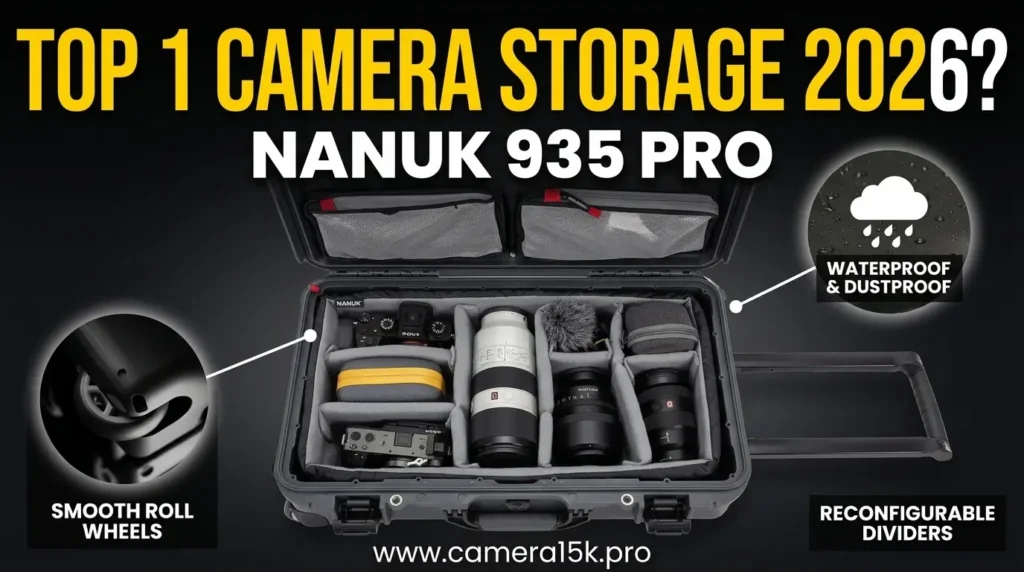
1. NANUK 935 Pro Photo Kit: The Industry Standard for Mobile Protection https
- Check Price & Availability — Link amazon
Structural Innovation and Material Science
The NANUK 935 Pro Photo Kit remains the quintessential choice for photographers who require an airline carry-on approved solution without sacrificing the near-indestructible nature of a hard case. Built from NANUK’s proprietary NK-7 resin, the case is engineered for the rigors of modern travel, offering a lightweight yet resilient shell that can withstand extreme impacts and pressures.
The standout feature of the NANUK 935 is the PowerClaw latching system. This patented mechanism uses compressive force to create a watertight seal that meets IP67 standards, ensuring that when storing camera equipment in maritime or rain-heavy environments, the internal cavity remains dry even under temporary submersion. Unlike traditional latches that may pop open upon high-impact drops, the PowerClaw requires a multi-stage release that provides absolute security during rough handling by airport crews.
The wheels are composed of polyurethane molded over polycarbonate, a design that mimics high-end rollerblade wheels. This choice is critical for the “mobile studio” concept, as it minimizes the transmission of high-frequency vibrations from the ground to the camera sensors and lenses stored inside.
Internal Ecosystem and Organizational Utility
The Pro Photo Kit includes a specialized padded divider system and a transparent lid organizer. The dividers are crafted from high-density, closed-cell foam that does not absorb moisture, a vital detail for preventing internal humidity build-up. The lid organizer adds three transparent, zippered compartments that are ideal for storing camera equipment such as cables, filters, and small electronics.
| Feature | Technical Specification | Benefit for the Practitioner |
| Exterior Dimensions | 22″ x 14″ x 9″ | Meets most airline carry-on requirements. |
| Interior Volume | 28.5 Liters | Ample space for 2 bodies and 5-7 lenses. |
| Ingress Protection | IP67 (Water/Dust) | Full immersion protection for 30 minutes. |
| Handle System | 2-Stage Retractable | Ergonomic transport for users of all heights. |
| Pressure Valve | Automatic Equalization | Prevents “vacuum lock” during altitude changes. |
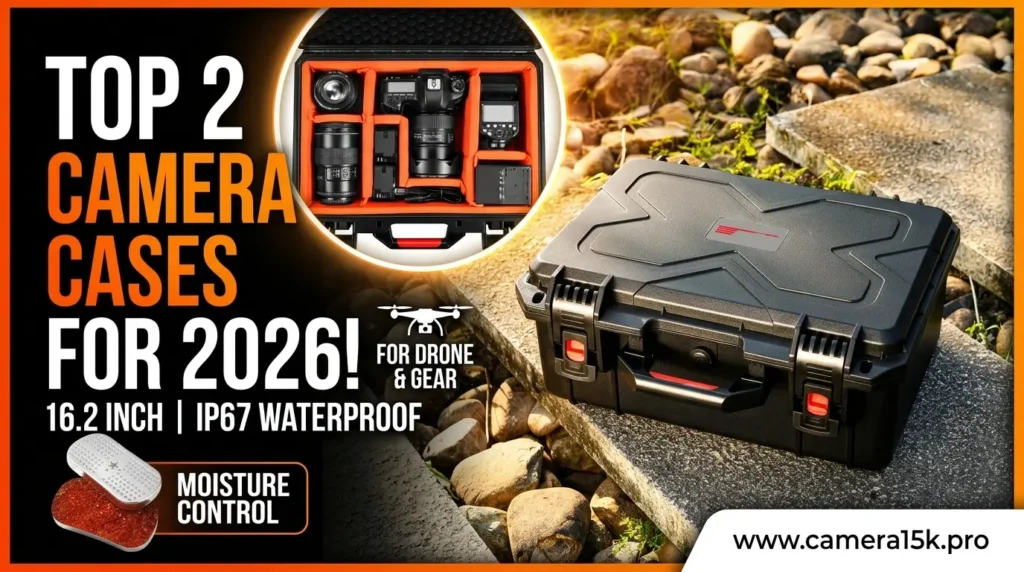
2. The 16.2-Inch Professional Waterproof Hard Case: Optimized for Specialized Gear
- Check Price & Availability — Link amazon
This specialized case has gained significant traction in 2026 for its unique ability to bridge the gap between drone storage and long-range telephoto lens protection. It is frequently cited as the premier solution for storing digital camera setups involving the Sony FE 400-800mm f/6.3-8 G OSS lens or the DJI Mavic drone series.
Precision Engineering for Heavy Optics
The case is constructed from high-strength polypropylene (PP) with an interior lined in EVA partitions and soft suede. This material combination is specifically designed to provide “anti-smashing” protection, a critical requirement when transporting the heavy, glass-dense elements of a telephoto lens. The 16.2-inch length is perfectly calibrated to accommodate long-range zooms while maintaining a footprint that is easy to manage in the field.
Active Moisture Management
A distinguishing factor of this case is the inclusion of a dedicated chamber for drying beads (silica gel). When storing camera gear at home or during travel, the air trapped inside the case can contain ambient moisture. The integrated desiccant system ensures that this moisture is stripped from the air, maintaining a dry internal environment that prevents mold from forming on the internal lens elements or the camera sensor.
Security and Pressure Relief
The dual-button locking mechanism provides a superior seal compared to standard latches. Users must press a safety button before the latch can be engaged, preventing accidental openings. Furthermore, the automatic exhaust valve is essential for maintaining consistent internal pressure, which protects sensitive O-ring seals from deforming during pressure shifts in cargo holds.
| Specification | Metric / Detail | Reference |
| External Dimensions | 41.1 x 32.5 x 17.8 cm | |
| Weight (Only Case) | 6.38 lbs (2.89 kg) | |
| Waterproof Rating | IP67 | |
| Interior Layout | 7 Movable Velcro Dividers | |
| Primary Application | Drones, Telephoto, Video Gear |
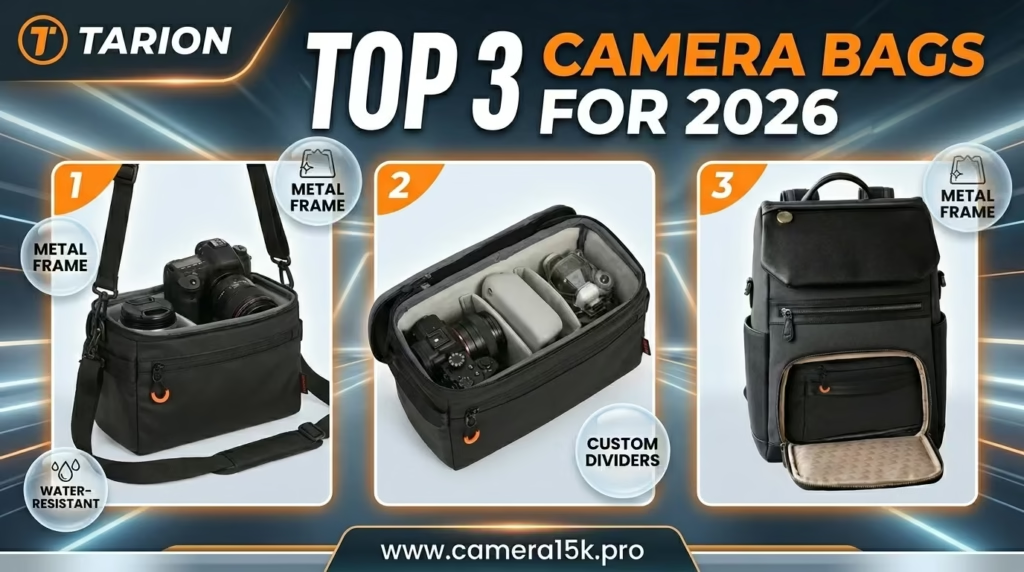
3. TARION ShellCore Series: The Steel-Framed Modular Revolution
- Check Price & Availability — Link amazon
The TARION ShellCore series, particularly the ShellCore XS and M models, represents a paradigm shift in how photographers approach storing camera equipment within existing luggage. Instead of relying solely on foam, TARION uses a rigid steel frame to maintain the insert’s structure under extreme external pressure.
Structural Resilience and Material Composition
The “ShellCore” name refers to the reinforced frame that prevents the insert from collapsing when packed at the bottom of a heavy suitcase or hiking backpack. The exterior is crafted from 1200D polyester, a high-density fabric that offers significant abrasion resistance, while the interior uses “pearl-cotton” padding to absorb vibrations.
The ShellCore XS is an ultra-compact solution (10.2 x 4.9 x 6.3 inches) designed to hold one camera and two lenses. For larger kits, the ShellCore M expands the capacity to 15 liters, providing space for two cameras and seven lenses, making it a viable option for a professional’s “workday” setup.
Hybrid Functionality and Accessibility
One of the most praised aspects of the ShellCore series is its dual-access capability. It features a side-access panel for quick camera retrieval—ideal when the insert is placed inside a backpack with side openings—and a full back-opening panel for comprehensive kit organization. Furthermore, the inclusion of exterior strap connectors allows the insert to be used as a standalone shoulder bag, providing maximum versatility for the “on-the-go” content creator.
| Feature | XS Model | M Model |
| Capacity | ~5 Liters | 15 Liters. |
| Weight | 0.7 lbs | 1.2 lbs. |
| Frame | Rigid Steel | Rigid Steel. |
| Dividers | 2 Adjustable | 7 Adjustable. |
| Primary Use | Minimalist Travel | Full Professional Kit. |
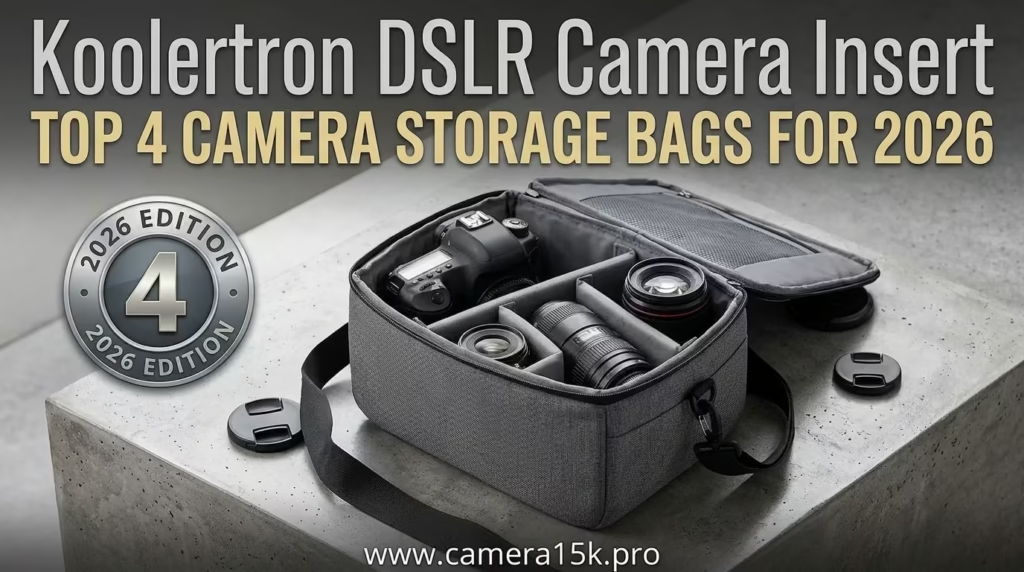
4. Koolertron DSLR Camera Insert: The Velvet Vault for Urban Gear
- Check Price & Availability — Link amazon
The Koolertron DSLR Camera Insert Bag is the premier choice for practitioners who prioritize weight and interior texture when storing camera gear at home or within a daily messenger bag. Its focus on “anti-static” materials addresses a subtle but important risk: the accumulation of dust on the sensor due to static charge.
Anti-Static Liners and Protective Textures
The Koolertron utilizes a high-quality velvet liner that is not only soft to the touch but also pliable and flexible. This material choice is specifically designed to prevent the micro-scratches that can occur when a camera body rubs against more abrasive polyester fabrics. The anti-static composite material used in the sleeve further reduces the likelihood of dust bunnies appearing in images—a constant battle for those using mirrorless systems with exposed sensors.
Waterproofing and Urban Utility
While the bag is primarily an insert, Koolertron has integrated a waterproof sleeve and high-density EVA padding, offering a level of “all-around” protection that is often missing from entry-level inserts. The drawstring or zippered top (depending on the specific version) allows the user to quickly seal their gear away from the dust and debris found at the bottom of a standard backpack.
| Attribute | Specification | Reference |
| Material | Velvet + Polyester + Cotton | |
| External Size | 27 x 16 x 12 cm | |
| Internal Dividers | Adjustable via Velcro | |
| Weight | 160g | |
| Color Options | Black, Blue, Gray, Green |
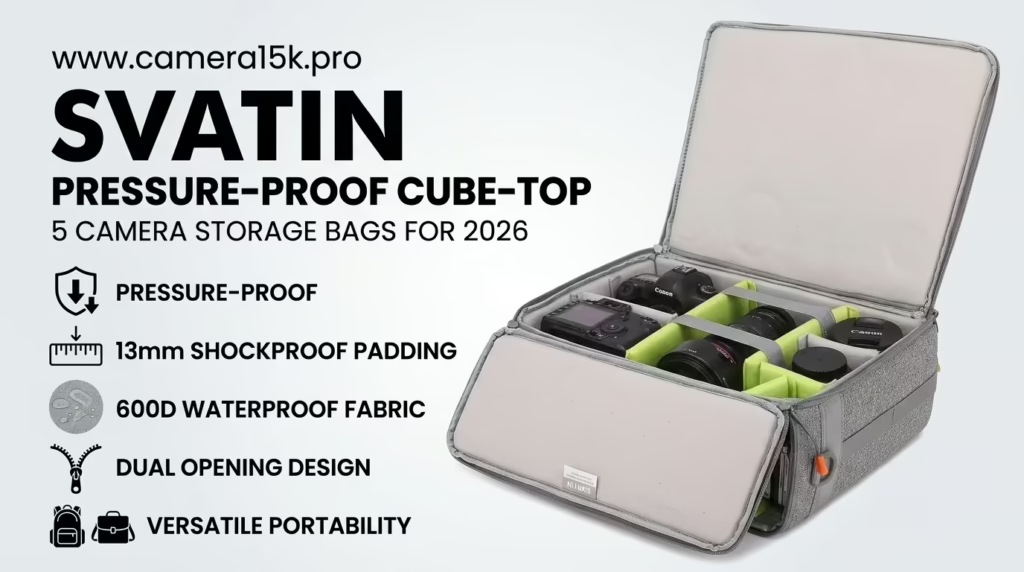
5. SVATIN Pressure-Proof Cube: The Mountaineer’s Internal Defense
- Check Price & Availability — Link amazon
The SVATIN Camera Insert Bag (Size L) is engineered for the “hardcore enthusiast” who needs a high-capacity internal organizer that can survive being crushed inside a mountaineering pack. It is one of the few inserts on the market that explicitly advertises a weight-bearing capacity for its structural walls.
Multi-Layer Pressure Resistance
The SVATIN cube features a “sandwich” wall construction. The core is a hard PP (polypropylene) plate that provides the primary resistance against crushing forces, supported by inner and outer layers of soft PE (polyethylene) foam. This engineering allows the body of the case to withstand up to 6.6 pounds of weight without deforming, protecting the delicate internal alignment of the cameras and lenses stored inside.
High-Capacity Organization
The “L” model is designed to fit in backpacks over 20 liters and can accommodate two camera bodies with 70-200mm f/2.8 lenses attached, plus additional flashes and batteries. The dual-opening design—a “cabin door” on the top and a full side zipper—allows the photographer to access their primary gear quickly while still being able to perform comprehensive internal organization.
| Size / Capacity | Interior Dimensions | Storage Capability |
| Small (S) | 9.05″ x 6.69″ x 4.92″ | 1 DSLR + 1 Lens. |
| Medium (M) | 12.2″ x 7.87″ x 4.92″ | 1 DSLR (70-200mm) + 2 Lenses. |
| Large (L) | 14.56″ x 10.6″ x 4.92″ | 2 Pro DSLRs + 4-5 Lenses. |
Expert Maintenance and the Philosophy of Gear Longevity
Storing camera equipment is not a passive activity; it requires a systematic approach to cleaning and environmental monitoring. Field experts, including photographers like Kevin Pepper and specialists from Sony, advocate for a “nightly ritual” and a “post-trip reset” to ensure gear remains in peak condition.
The Nightly Field Ritual
When traveling, the risk to gear is at its highest. Every night, practitioners should perform a “once over” cleaning:
- Dust Removal: Use a blower or brush to remove loose grit from the body and lens barrel.
- Surface Wiping: Use a soft microfiber cloth to remove skin oils and perspiration, which can be acidic.
- Battery Management: Top off all batteries and inspect them for swelling.
- Data Backup: Download all images and clear memory cards, ensuring the “storing camera sd card” assets are kept in a separate, secure pouch.
Long-Term Home Storage: The Sony Standards
For storing camera gear at home over weeks or months, the strategy must be more robust. Sony’s official guidelines emphasize the use of a “dry box”—either a simple airtight plastic container with a manual desiccant or an electronic dry cabinet. The cabinet should be set to 40%–50% RH and placed in a well-ventilated area away from direct sunlight. If a dry cabinet is not available, using labeled plastic tubs in a dry basement or dedicated closet is a viable alternative, provided a hygrometer is used to monitor conditions.
Digital Storage and the Physical Archive
The act of storing video camera footage or high-resolution RAW files requires as much physical infrastructure as the cameras themselves. In 2026, the volume of data produced by a single shoot can easily reach several terabytes, making “storing camera hard drive” assets a primary concern for the studio professional.
HDD vs. SSD: A Strategic Choice
When selecting drives for archiving, practitioners must balance speed with reliability:
- SSD (Solid State Drive): Ideal for active working files and short-term storage. Drives like the Samsung T7 or LaCie Rugged SSD provide high speed and impact resistance, making them perfect for field use.
- HDD (Hard Disk Drive): Preferred for long-term, high-capacity cold storage. While slower and more fragile than SSDs, HDDs offer a better price-per-terabyte ratio for massive archives.
| Media Type | Recommended Use | Key Advantage |
| SD Card / CFexpress | Capture & Temporary Storage | High write speeds. |
| Portable SSD | Active Editing & Travel Backup | Rugged, fast transfer. |
| Desktop HDD / RAID | Long-Term Archive | High capacity, redundancy. |
| Cloud (S3 / Backblaze) | Offsite Redundancy | Protection against fire/theft. |
Data Preservation Best Practices
The “storing camera book” concept has transitioned into digital asset management (DAM). Experts recommend renaming every folder and file by date and client name (e.g., YYYY_MM_DD_Client_Project) to ensure searchability decades into the future. Furthermore, embedding keywords directly into image metadata ensures that files remain findable even if moved between different software platforms.
Future Innovations in Camera Storage for 2026 and Beyond
As we move toward the second half of the decade, the industry is witnessing the integration of “smart” features into traditional storage hardware. The expansion of the Internet of Things (IoT) has led to the development of smart dry cabinets, such as the SmartDRY series, which offer mobile connectivity and 24/7 data tracking for humidity and temperature.
Smart Tracking and Theft Prevention
The “storing camera” keywords of the future will likely include “GPS-enabled” and “biometric-locked.” High-end cases from brands like Ruggard are already incorporating fingerprint scanners for security, while newer camera backpacks are integrating GPS tracking to help professionals recover gear in the event of theft during travel.
Sustainability and Material Ethics
There is a profound move toward sustainable manufacturing. The “sustainability winners” of 2026 are brands using recycled resins (like the NANUK-R series), biodegradable fabrics, and low-impact dyeing processes. Consumers are increasingly prioritizing gear that offers a lifetime warranty and high repairability, reducing the environmental impact of the photographic industry.
Conclusions and Practical Guidance for the Modern Photographer
The comprehensive analysis of the top five camera storage solutions reveals that there is no single “best” bag, but rather a best tool for specific scenarios. Selecting the right solution requires an honest assessment of one’s environment and mobility needs.
Actionable Recommendations for Practitioners
- For the Global Traveler: Prioritize hard-shell, airline-compliant cases like the NANUK 935. The PowerClaw latches and pressure relief valves are essential for the survival of gear in cargo holds and high-altitude environments.
- For the Specialized Wildlife or Video Producer: Invest in a dedicated hard case for telephoto lenses and drones, ensuring it includes a desiccant chamber to actively manage humidity during field deployments.
- For the Urban Content Creator: Utilize high-quality inserts like the TARION ShellCore or Koolertron. The ability to move gear between different casual bags while maintaining structural or anti-static protection is a major workflow advantage.
- For the Home Collector: If “storing camera gear at home” is the primary goal, an electronic dry cabinet is the only way to ensure absolute protection against fungal growth and atmospheric degradation.
- For the Data-Conscious Professional: Adhere to the 3-2-1 backup strategy and invest in high-quality anti-static media cases to protect the physical integrity of your SD cards and hard drives.
Storing camera equipment correctly is a foundational skill that separates the amateur from the professional. By understanding the physics of humidity, the mechanics of stress on lens mounts, and the material science of protective resins and steel frames, photographers can ensure their equipment remains as capable in 2036 as it was in 2026. The evolution of storage is an evolution of creativity; when the tools are protected, the artist is free to focus entirely on the image.